
Introduction
ATSScores is an AI resume tailoring tool for job seekers who want to compare a resume against a specific job description and identify missing ATS keywords more quickly. The public page presents it as a faster alternative to broad ChatGPT resume rewrites, with a focus on precise edits, keyword gaps, and job-specific suggestions rather than rewriting an entire resume from scratch.
The clearest fit is for candidates applying to many roles who already have a resume but need a more efficient way to adapt it for each posting. Readers should still treat the tool as an optimization aid, not a guarantee of interview outcomes, and verify the final wording against their real experience before sending applications.
Key Features
- Resume keyword checking that compares a resume with a target job description and highlights missing terms.
- Job-specific suggestions for resume keywords, bullet points, and other resume sections.
- Precise edit guidance such as changing a specific bullet instead of producing a long generic rewrite.
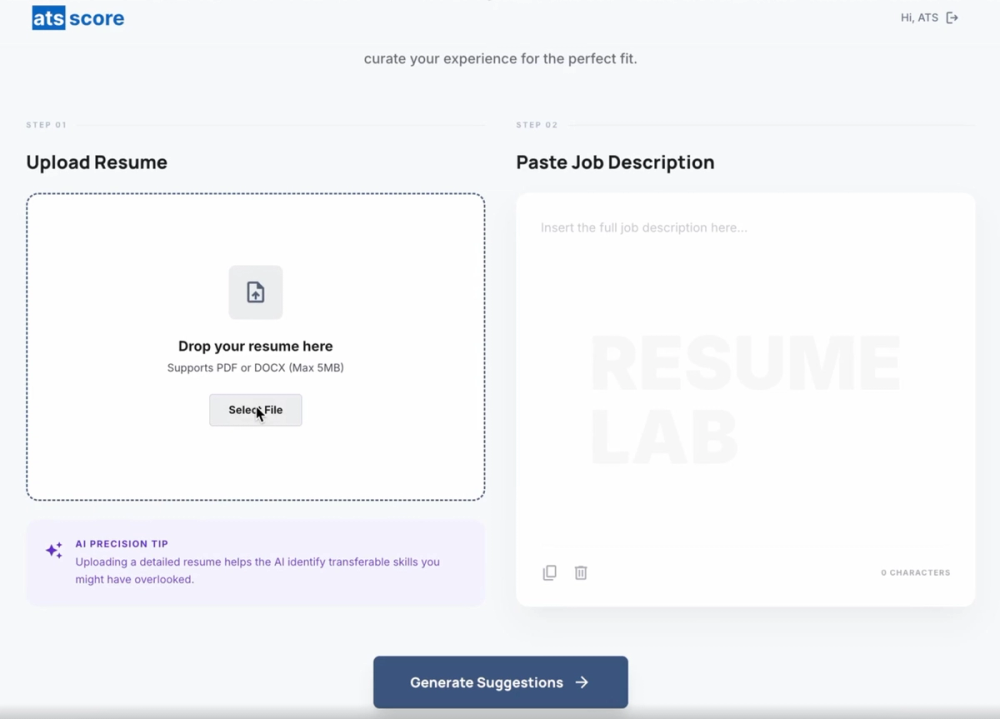
- Resume upload and scan flow designed to analyze structure, bullets, headers, and formatting once for repeated tailoring.
- Support signals for common resume formats, including PDF, Word, and Google Docs.
- Planned workflow additions shown on the site, including a Chrome extension for tailoring directly on LinkedIn job pages, one-click edits, and instant PDF download.
Use Cases
ATSScores appears most useful when a job seeker wants to tailor an existing resume to a specific role without comparing two long documents manually. The public page emphasizes pasting a job description, finding missing ATS keywords, and receiving targeted improvement suggestions tied to the candidate's current bullet points.
A practical use case is preparing multiple applications where each job description includes different tools, responsibilities, or domain terms. Instead of sending the same LinkedIn resume to every role, a candidate can use the product to spot gaps such as missing role-specific keywords and decide which edits are honest, relevant, and worth applying.
The tool may also help users who find generic AI resume prompts too broad. Its positioning suggests a narrower workflow: keep the candidate's story intact, identify resume gaps, and make smaller edits that better match a job posting. A careful user should still review each suggestion for accuracy, tone, and truthfulness before exporting or submitting the resume.
Pricing
The site describes ATSScores as a free AI resume keywords checker and also promotes "Free 1 month" access for early adopters. It does not show a full pricing table, paid tier structure, renewal price, or plan limits in the fetched page content, so users should confirm what happens after the first month, whether usage limits apply, and which features are included before relying on it for an extended job search.
User Experience and Support
The public page presents a workflow built around uploading a resume, pasting a job description, reviewing suggestions, and applying edits. The demo copy shows an ATS match score, keyword examples such as React, Figma, UX Research, Agile, and Design Systems, and suggested bullet improvements that can be accepted or dismissed.
Support and documentation details are less explicit. The site includes guide-style wording about using AI to optimize a resume with keywords for a job description, but it does not clearly show a help center, support email, live chat, or detailed documentation path in the fetched evidence. Users who expect hands-on support, account help, or resume-review guidance should check available support routes before depending on the product during an active application cycle.
Technical Details
ATSScores is presented as an AI-assisted resume tailoring tool that scans resume structure and compares it with job-description content. The page states that it works with PDF, Word, and Google Docs formats, and it mentions uploaded LinkedIn resumes or other resume files as part of the intake flow.
The site also describes upcoming or future-facing features, including a Chrome extension for tailoring a resume directly on LinkedIn job pages, one-click edits, and instant PDF export. The fetched page does not provide deeper technical details such as model providers, data retention settings beyond the stated "we don't store or share your files" claim, API access, browser-extension release status, or integration documentation. Those points are worth verifying if privacy, compliance, or workflow integration is important.
Pros and Cons
Pros
- Focuses on concrete resume tailoring tasks rather than broad resume rewriting.
- Highlights missing ATS keywords and job-specific suggestions from a pasted job description.
- Appears designed for repeated applications where candidates need faster resume adaptation.
- Shows support for common resume file formats, including PDF, Word, and Google Docs.
- The public page gives a clear product promise around precise edits and keyword gaps.
Cons
- Full pricing details and post-trial terms are not visible on the fetched page.
- Support channels and documentation depth are not clearly shown.
- Some capabilities, including the Chrome extension and one-click export workflow, appear to be positioned as future or upcoming features.
- Users still need to review every suggested edit to make sure it accurately reflects their experience.
- The page's ATS score example is useful for understanding the concept, but it should not be treated as an independently verified hiring outcome.
FAQ
What is ATSScores used for?
ATSScores is used to compare a resume with a job description, identify missing resume keywords, and suggest targeted edits for improving job-specific fit. The public page frames it as an AI resume keyword checker and resume tailoring tool for job hunters.
Who is ATSScores best suited for?
It appears best suited for job seekers who already have a resume and need to tailor it repeatedly for different roles. It may be especially relevant for candidates applying through LinkedIn or other job boards where each posting uses different keywords and requirements.
How is ATSScores different from using ChatGPT for resume edits?
The site positions ATSScores as more focused than generic ChatGPT resume rewrites. Instead of rewriting the whole resume, it emphasizes missing keywords, precise bullet-level suggestions, and edits tied to the user's existing resume content.
What resume formats does ATSScores mention?
The public page says the tool works with PDF, Word, and Google Docs formats. Users should still confirm formatting quality after any export or edit, especially if they rely on a specific resume template.
Does ATSScores show pricing publicly?
The fetched page mentions a free AI resume keywords checker and "Free 1 month" for early adopters. It does not show a complete pricing table, so users should verify renewal pricing, limits, and plan availability before making it part of a longer job-search workflow.
Does ATSScores provide support or documentation?
The page includes guide-style content about using AI to optimize resume keywords, but it does not clearly surface detailed support channels in the fetched content. Users who need account help, resume guidance, or technical support should check the site for current contact or help options.
Can ATSScores tailor a resume directly on LinkedIn?
The site mentions a Chrome extension for tailoring a resume directly on LinkedIn job pages as part of its future LinkedIn resume optimizer direction. Readers should verify whether that extension is currently available, in early access, or still planned before relying on it.
What should users check before applying ATSScores suggestions?
Users should confirm that each suggested keyword, bullet edit, and skill reference is truthful and tied to their actual experience. Resume optimization can improve relevance, but inaccurate claims can create problems during interviews or background checks.
Conclusion
ATSScores presents a focused approach to AI resume tailoring: identify missing ATS keywords, suggest precise edits, and help job seekers adapt a resume to specific postings without starting from a blank page. Its strongest visible value is speed and specificity, while the main points to verify are pricing, support routes, data-handling details, and the status of upcoming LinkedIn or Chrome-extension features.
For candidates who apply to many roles, ATSScores may be a practical way to make resume tailoring less repetitive. It works best when users treat its suggestions as structured editing guidance and keep final responsibility for accuracy, relevance, and formatting.