
Introduction
Shipstry is a weekly product launch registry for makers who want to present new apps, AI tools, developer products, and other digital products in a timed launch environment. The public site describes defined ship weeks, reviewed listings, blind voting, and plan-based visibility options for products that want a clearer launch window.
The clearest value is structured discoverability: Shipstry gives makers a place to list a product with launch timing, category context, and backlink options. It appears most useful for indie makers and startup teams that already have a product page ready, while careful users should verify review timing, backlink placement, refund rules, and current discount availability before choosing a paid plan.
Key Features
- Weekly product registry organized around ship weeks and current launch windows.
- Reviewed listings for maker-built apps, AI tools, developer products, and related software categories.
- Blind voting mode where products are shuffled and votes are hidden until a reveal time.
- Public discovery areas for shipped products, winners, categories, blog posts, and featured placements.
- Free Harbor plan with a longer queue, nofollow backlinks, and one monthly submission.
- Paid Voyage plan with same-week queue, faster review, and dofollow backlinks.
- Flagship option for flexible featured placement by day.
- Navigation for submit guidelines, badges, feedback, changelog, sitemap, privacy, terms, and refund information.
Use Cases
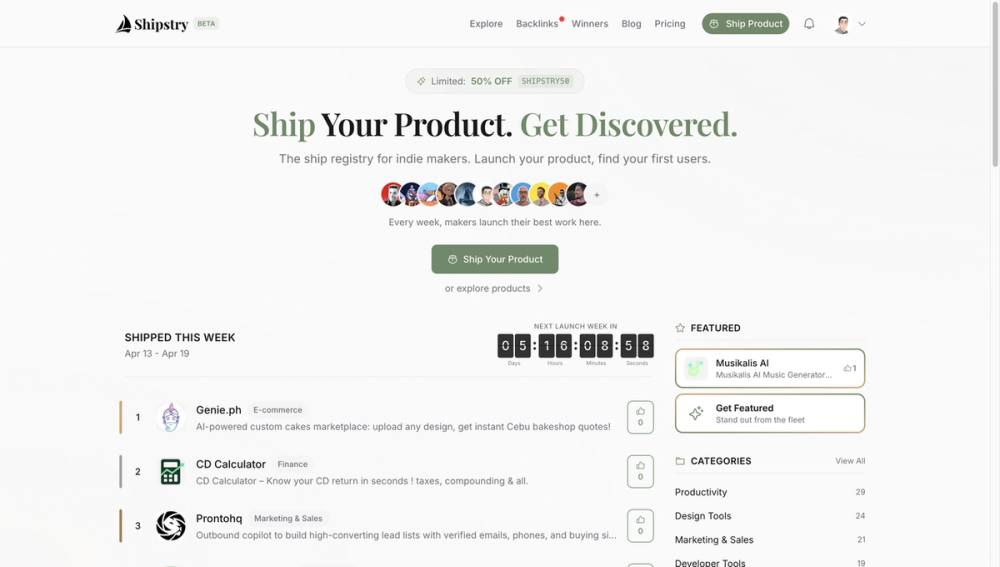
Shipstry is useful for makers who want their product launch to sit inside a public weekly cycle instead of appearing as an isolated post. A founder can use the Shipstry homepage to understand what is shipping that week, how categories are presented, and how products appear to early adopters browsing the registry.
It also fits teams that care about backlink structure and launch timing. The pricing copy states that plans change timing, backlink strength, and featured visibility, so the product is relevant for makers comparing a slower free listing with faster review or paid visibility.
The platform may be especially practical for small products that benefit from category discovery, including productivity tools, AI and machine learning products, design tools, developer tools, education products, and marketing tools. Shipstry does not replace a strong landing page or launch message; it gives that launch another structured surface.
Pricing
Shipstry's pricing page says every product can ship and that pricing changes timing, backlink strength, and featured visibility during the ship week. Harbor is free and lists 3 nofollow backlinks, 1 submission per month, full-week exposure, a 3+ week queue, and review within 4 weeks. Voyage is shown at $9.9 per ticket with 4 dofollow backlinks, no submission cap, full-week exposure, same-week queue, and review within 24 hours. Flagship is shown at $3 per day per cabin with flexible featured placement from 1 day, plus the same dofollow backlink and 24-hour review signals shown for paid placement. The homepage also displays a limited-time discount code, so users should confirm whether the promotion is still active.
User Experience and Support
The public experience is built around browsing products by week, checking current shipped products, viewing winners, reading launch-related blog posts, and choosing a listing plan. The ship-week countdown, status messages, blind voting, and featured placement areas help make the launch cycle visible to both makers and early adopters.
Support and policy information appears through self-serve navigation rather than a personal launch concierge. The site links to submit guidelines, pricing FAQ, badges, feedback, changelog, sitemap, privacy, terms, and refund pages. Makers with strict launch timing or SEO expectations should read those pages before paying, because plan details affect review windows and backlink treatment.
Technical Details
Shipstry is a web-based launch registry with public product listings, category pages, weekly launch cycles, voting mechanics, winners pages, badges, backlinks, blog content, and sitemap resources. The navigation also includes an LLM.txt link, which may be relevant for teams interested in machine-readable discovery signals.
The fetched evidence does not show a public API for automated product submission, a detailed analytics dashboard for submitters, or traffic forecasts. For SEO-focused launches, the most important technical details to verify are whether links are nofollow or dofollow, where links appear, how long listing pages remain visible, and whether featured placement affects only the ship week or additional surfaces.
Pros and Cons
Pros
- Gives maker-built products a defined weekly launch context.
- Free and paid options make timing and backlink trade-offs clear enough for initial evaluation.
- Blind voting and Fog Mode create a more structured discovery mechanic than a simple chronological list.
- Public categories, winners, badges, blog posts, and sitemap resources support broader browsing.
- Paid plans offer faster review windows for makers with tighter launch schedules.
Cons
- The free Harbor plan has a longer queue and nofollow backlinks, which may not suit time-sensitive launches.
- Paid visibility does not remove the need for clear positioning, a useful product, and independent promotion.
- Makers should confirm refund terms, tax handling, backlink locations, and upgrade rules before payment.
- The fetched evidence does not show detailed submitter analytics or automated submission tooling.
- Outcomes will vary by category fit, launch timing, product quality, and audience interest.
FAQ
What is Shipstry?
Shipstry is a weekly product launch registry where makers can list new products and early adopters can discover what is launching. It uses ship weeks, reviewed listings, voting mechanics, categories, and plan-based visibility options.
Who should use Shipstry?
Shipstry appears best suited for indie makers, startup founders, AI tool builders, developer product teams, and small software creators who want another discovery surface for a launch. It is most useful when the product already has a clear landing page and launch message.
How does Shipstry pricing work?
Pricing changes queue timing, backlink strength, review speed, and featured visibility. The free Harbor option has a slower queue and nofollow links, while Voyage and Flagship provide faster review and dofollow backlink signals shown on the pricing page.
What is the difference between Harbor, Voyage, and Flagship?
Harbor is the free plan with 3 nofollow backlinks, 1 submission per month, a 3+ week queue, and review within 4 weeks. Voyage is listed at $9.9 per ticket with 4 dofollow backlinks, no submission cap, same-week queue, and review within 24 hours. Flagship is listed at $3 per day per cabin and adds flexible featured placement.
Does Shipstry promise traffic or rankings?
The public evidence does not show a traffic, ranking, or conversion commitment. Shipstry can provide a launch registry listing and visibility mechanics, but results still depend on product quality, positioning, category fit, and audience demand.
Are Shipstry backlinks nofollow or dofollow?
The pricing page shows nofollow backlinks for the free Harbor plan and dofollow backlinks for paid plans. Makers should review the current pricing FAQ to confirm where the links appear and whether the terms match their SEO needs.
What should makers check before submitting?
Makers should verify submit guidelines, review timing, refund policy, tax handling, backlink locations, upgrade rules, badge requirements, and current discount terms. These details matter because pricing is tied to timing and visibility.
Is Shipstry only for AI products?
No. The homepage includes AI tools, but it also lists categories such as productivity, marketing and sales, design tools, developer tools, education, finance, travel, health and wellness, and social products. The broader positioning is a launch registry for maker-built products.
Conclusion
Shipstry gives makers a structured way to place a product into a weekly discovery cycle with visible plan differences for timing, backlinks, and featured placement. It is most useful as a launch registry and discovery surface, while founders still need strong product positioning and their own promotion to make the launch effective.