
Introduction
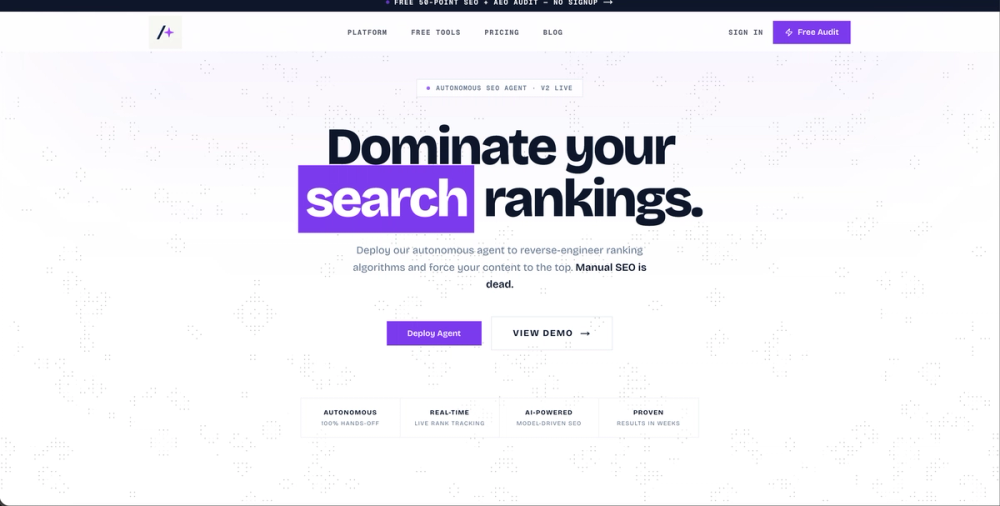
Stackwise Rank presents itself as an AI visibility tracker and autonomous SEO agent for teams that want to monitor how often their brand is cited across ChatGPT, Perplexity, Claude, Gemini, and Google AI Overviews. The public page combines AI citation tracking, automated audits, content generation, and publishing into a single SEO workflow.
That makes it most relevant for SEO and growth teams that care about AI answer engines as much as traditional search. The Stackwise Rank homepage frames the product less as a dashboard and more as an operating layer for site-level SEO work, which is a meaningful distinction for buyers deciding whether they want monitoring, automation, or both.
Key Features
- AI visibility tracking shows when AI engines cite your brand or a competitor, with query-level breakdowns and a composite score.
- The platform says it tracks seven AI engines daily in its visibility workflow, which gives it a broader scope than a single-engine monitor.
- A 33-point technical and content audit runs automatically, covering schema, crawlers, Core Web Vitals, content structure, indexing signals, and more.
- Auto-remediation is a notable differentiator: the agent can open GitHub pull requests to fix issues instead of only flagging them.
- The content engine is built to generate SEO- and AEO-oriented content tuned for AI citation workflows, including keyword-gap analysis and page optimization.
- Publish-and-monitor support connects to WordPress, Webflow, and Shopify, so the product is not limited to analysis alone.
- The pricing page shows sentiment analysis, share-of-voice analytics, competitor citation alerts, and white-label client portal options on higher plans.
Use Cases
Stackwise Rank appears best suited to teams that already treat SEO as an operational process rather than a one-off reporting task. Agencies, in-house growth teams, and content teams can use it to spot when AI engines cite a competitor instead of their own pages, then decide whether the fix is technical, editorial, or both.
It also seems useful for organizations that need tighter feedback loops between audit, content, and publishing. The public page shows a path from domain connection to audit, GitHub pull requests, CMS updates, and daily snapshots, which suggests the product is designed for teams that want SEO work to keep moving after the first report is generated.
A careful reader should still verify where the automation ends and human review begins. The site makes strong claims about autonomous fixes and content generation, but your internal workflow may still need approval steps, CMS permissions, or editorial review before anything ships.
Pricing
Pricing starts with a free plan, and the site emphasizes that you can begin without a card. The public pricing page shows a Starter tier, a Pro tier, and an Agency tier, with the pricing page framing the product as something that starts free and scales as you add more engines, audits, and team features.
The visible plan structure matters more than a single headline price because the feature mix changes quickly by tier. Starter is positioned for solo SEOs, Pro for serious teams, and Agency for larger client operations, so buyers should check the included engines, audit counts, user seats, and automation limits before assuming the free tier is enough.
User Experience and Support
The product looks fairly opinionated, which can be good if you want a guided workflow. The page walks users through connect, audit, fix, and grow, and it also exposes documentation and FAQ links, which makes the platform feel more structured than a simple rank-tracker.
Support signals are stronger on the paid tiers, where the site mentions email support, priority support, dedicated account management, and even phone plus Slack Connect on the top plan. That range is a positive sign for teams, but it is still worth checking response expectations and whether support is tied to plan level in the way you need.
Technical Details
Stackwise Rank is clearly built with technical SEO and automation in mind. The page references Google Search Console connection, GitHub pull requests, CMS publishing, REST API access, webhook publishing for custom CMS setups, and integrations with WordPress, Webflow, Shopify, and Slack.
It also exposes a fairly detailed technical audit surface, including schema markup, robots.txt, XML sitemaps, URL structure, accessibility, hreflang, and llms.txt compliance. The strongest technical signal is that it tries to bridge content, indexability, and AI-citation signals in one place rather than separating them into isolated tools.
Pros and Cons
Pros
- Combines AI visibility tracking with technical SEO automation, which reduces tool switching.
- The GitHub pull request flow suggests a practical path from diagnosis to fix.
- Multiple integrations make it relevant to real publishing workflows.
- The free plan and no-card start lower the barrier to evaluation.
Cons
- The platform is broad enough that smaller teams may need time to understand which features actually matter.
- Some of the marketing language is aggressive, so buyers should separate positioning from verified capability.
- The deepest automation and white-label features appear reserved for higher tiers.
- Teams that only need a simple rank tracker may find the broader agent stack unnecessary.
FAQ
What is Stackwise Rank, and what problem does it solve?
Stackwise Rank is an AI visibility tracker and autonomous SEO platform. It is built to show how often AI engines cite your brand, identify when competitors are being cited instead, and then help fix the technical or content issues that may be holding you back.
Who is Stackwise Rank best suited for?
It appears most relevant for SEO teams, agencies, and growth teams that want monitoring and remediation in one system. The plans and feature set suggest it is also a fit for organizations managing multiple sites or client accounts.
What can users clearly verify from the public site?
Users can verify AI visibility tracking, daily snapshots, technical audits, GitHub-based fixes, CMS publishing, content generation, share-of-voice analytics, and sentiment analysis. The pricing page also shows tiered plans, user-seat differences, and support levels.
How does the automation side of Stackwise Rank work?
The site says the agent can open GitHub pull requests, update a CMS, and submit sitemaps to Google and Bing after an audit finds issues. That suggests a hands-on remediation loop, but teams should still verify what requires approval and what can run automatically in their own setup.
What should a buyer check before adopting Stackwise Rank?
A buyer should verify engine coverage on the plan they want, how many audits or fixes they actually need, and whether the CMS and GitHub integrations match their workflow. It is also worth checking the review process for automated fixes so the tool fits internal governance requirements.
Does Stackwise Rank support WordPress, Webflow, Shopify, or custom CMS workflows?
Yes, the public page explicitly mentions WordPress, Webflow, Shopify, REST API access, and webhook publishing for custom CMS setups. That makes it more credible for publishing teams than a tracker that stops at reporting.
Is Stackwise Rank only about AI citations, or does it also cover traditional SEO?
It covers both. The site includes AI citation tracking, but it also highlights technical audits, backlink monitoring, Core Web Vitals, schema, sitemaps, and daily rank tracking, which shows a broader SEO scope.
Conclusion
Stackwise Rank looks like a serious fit for teams that want AI citation visibility, technical SEO checks, and automated fixes in one platform. The combination of free entry, strong integrations, and agent-based remediation is compelling, but buyers should still validate plan limits and automation boundaries before making it part of a production workflow.