
Introduction
Stackwise Rank positions itself as an autonomous SEO agent designed to track AI visibility across modern search engines like ChatGPT, Perplexity, Claude, Gemini, and Grok. The platform aims to replace manual SEO workflows with automated audits, AI-powered content generation, and direct publishing integrations.
For growth teams navigating the shift from traditional search to AI-powered answer engines, Stackwise Rank offers a consolidated dashboard that attempts to bridge both worlds-monitoring traditional SERP rankings while tracking how often AI engines cite your brand versus competitors.
The tool appears particularly relevant for SEO professionals, content marketers, and agencies managing multiple client sites who need visibility into how large language models perceive and reference their content.
Key Features
Stackwise Rank organizes its capabilities around four primary modules:
AI Visibility Tracking The platform monitors brand citations across seven AI search engines including ChatGPT, Perplexity, Claude, Gemini, and Grok. Users receive a composite visibility score (0-100) with query-level breakdowns showing when competitors appear in AI responses instead of their own brand. Daily snapshots track changes over time, and sentiment analysis classifies mentions as positive, neutral, or negative.
Smart Audit System A 33-point technical and content audit runs automatically on a configurable schedule. The system checks Core Web Vitals, schema markup, AI crawler access (18 different bots), llms.txt compliance, and traditional SEO factors like title tags, meta descriptions, and heading hierarchy. Issues trigger automated GitHub pull requests with fixes for review and merge.
Content Engine Using Claude Sonnet 4.6 and Agent SDK, the platform generates SEO and AEO-optimized content specifically structured to earn citations from AI answer engines. Features include keyword gap analysis, semantic analysis, striking-distance query detection, and automated content calendar management. The system produces up to 80 AI-written articles per month on higher-tier plans.
Publish & Monitor Native integrations support direct publishing to WordPress, Webflow, and Shopify with Yoast and Rank Math SEO meta synchronization. The platform combines daily rank tracking via Serper API (positioned as 94% cheaper than DataForSEO alternatives), backlink monitoring through Ahrefs integration, and competitor citation alerts delivered via Slack and email.
Use Cases
Solo SEO Professionals The Starter plan targets individual practitioners managing 2-3 sites who need affordable visibility into AI search trends without enterprise tooling overhead.
In-House Growth Teams Companies with dedicated content and SEO operations can leverage the Pro tier's unlimited sites, sentiment analysis, and share-of-voice analytics to understand competitive positioning across AI engines.
SEO Agencies The Agency tier provides white-label client portals, custom AI system prompts per client, full REST API access, and webhook publishing for custom CMS integrations-positioning it for agencies managing multiple client SEO operations at scale.
AI-First Content Operations Teams experimenting with generative AI content strategies can use the automated content pipeline to identify gaps, draft articles optimized for LLM citations, and publish through integrated workflows.
Technical SEO Remediation Organizations with significant technical debt can connect GitHub repositories to receive automated pull requests fixing schema markup, missing alt tags, canonical issues, and robots.txt problems without manual developer intervention.
Pricing
Stackwise Rank offers four pricing tiers with monthly and annual billing options (annual includes 20% discount):
Free Plan
- $0, free forever
- 2 sites
- 2 AI audits per month
- 15 AI task fixes per month
- 1 AI engine (ChatGPT visibility only)
- 5 AEO snapshots per month
- 20 AI chat messages
- Basic 33-point SEO audit
- Community support
Starter Plan
- 3 sites
- 8 AI audits per month
- 3 AI engines (ChatGPT, Perplexity, Gemini)
- 30 AEO snapshots per month
- Daily AI visibility tracking
- 5 content planning sessions per month (up to 15 keyword briefs)
- 10 AI-written articles per month
- 200 AI task fixes per month
- 100 AI chat messages
- 2 user seats
- Email support
Pro Plan
- Unlimited sites
- 20 AI audits per month
- All 5 AI engines (adds Claude and Grok)
- 60 AEO snapshots per month
- Sentiment analysis on AI mentions
- Brand share-of-voice analytics
- 10 content planning sessions per month (up to 30 keyword briefs)
- 30 AI-written articles per month
- 1,000 AI task fixes per month
- Competitor citation alerts via Slack and email
- Auto-fix pull requests via GitHub
- WordPress and Webflow native publishing
- White-label PDF reports
- Schema markup auto-generation
- 5 user seats
- Priority support with 24-hour SLA
Agency Plan Everything in Pro plus:
- 60 AI audits per month
- 200 AEO snapshots per month
- Citation source breakdown (UGC, Editorial, Forum, Corporate)
- AI Visibility autopilot (gap detection → article drafting → publishing → re-measurement)
- 30 content planning sessions per month (up to 90 keyword briefs)
- 80 AI-written articles per month
- 5,000 AI task fixes per month
- White-label client portals with logo and brand color customization
- Custom AI system prompts per client
- Full REST API access
- Webhook publisher for custom CMS
- Unlimited user seats
- Dedicated account manager
- Phone and Slack Connect support
All paid plans include 14-day money-back guarantees. No credit card required to start Free plan.
User Experience and Support
The platform follows a four-step workflow: Connect (link Google Search Console or enter domain), Audit (automated 33-point technical and content analysis), Fix (automated PR creation or CMS updates), and Grow (monitoring citations, rankings, and backlinks).
Support tiers range from community support on Free plans to dedicated account managers with phone and Slack Connect access on Agency plans. Documentation and API reference materials are available for integration work. The 24-hour SLA on Pro and Agency plans suggests commitment to professional users.
User testimonials on the site cite time savings in technical SEO workflows and appreciation for automated remediation features, though these should be treated as marketing claims rather than verified independent reviews.
Technical Details
Integrations
- GitHub (for automated pull request generation)
- WordPress, Webflow, Shopify (native CMS publishing)
- Slack (competitor citation alerts)
- Ahrefs (backlink monitoring)
- Serper API (daily rank tracking)
- Google Search Console (traffic and indexing data)
Security & Infrastructure
- Encrypted OAuth tokens with AES-256 encryption at rest
- Per-organization isolation
- SOC 2 readiness mentioned (verify current certification status independently)
- Up to 16 concurrent worker runs with stale-run recovery
Audit Coverage (200+ Points)
- Technical SEO: Core Web Vitals, SSL validation, mobile viewport, schema markup
- Content Quality: Depth analysis, readability scoring (Flesch + Grade level), keyword density
- AI Readiness: llms.txt compliance, AI crawler access (18 bots), platform-specific AI scores for 6 engines
- Indexing: Sitemap submission, crawl status, hreflang internationalization
- Meta Data: Open Graph, Twitter Cards, robots.txt, canonical tags
API & Automation Full REST API available on Agency tier with webhook support for custom CMS publishing.
Pros and Cons
Pros
- Consolidated visibility across both traditional SERPs and AI answer engines
- Automated technical remediation via GitHub integration reduces developer dependency
- Query-level citation tracking shows specific competitor threats
- Content generation pipeline specifically optimized for LLM citation earning
- White-label capabilities and client portals for agency use
- 33-point audit covers both traditional SEO and emerging AI-readiness factors
- Free tier allows testing core functionality before financial commitment
Cons
- AI content generation limits (10-80 articles/month) may constrain high-volume operations
- Pricing transparency limited-specific tier costs not publicly displayed on pricing page
- Dependency on third-party APIs (Serper, Ahrefs) creates potential reliability chain
- Automated content quality requires human oversight and editorial review
- Limited to 5 AI engines currently tracked; new AI search entrants may lag in support
- SOC 2 "ready" status should be verified as current certification for security-sensitive organizations
FAQ
How does Stackwise Rank track AI visibility differently than traditional rank trackers? Traditional tools monitor position in search results pages. Stackwise Rank specifically tracks when and how AI answer engines like ChatGPT, Perplexity, and Claude cite your brand in responses to user queries. It measures both citation frequency and sentiment, providing visibility into a channel that standard SEO tools typically miss.
What is the difference between SEO and AEO optimization? SEO (Search Engine Optimization) focuses on ranking in traditional search results. AEO (Answer Engine Optimization) structures content specifically to be selected and quoted by AI answer engines. Stackwise Rank's Content Engine generates output designed for both-traditional ranking factors plus characteristics that increase likelihood of LLM citation.
How does the automated GitHub pull request feature work? After connecting your GitHub repository, the platform detects technical issues (missing alt tags, broken schema, incorrect robots.txt, missing llms.txt) and automatically opens pull requests containing fixes. Your team reviews and merges these PRs, reducing manual code changes while maintaining human oversight of production deployments.
Can Stackwise Rank replace tools like Ahrefs or SEMrush? The platform positions itself as a consolidated alternative with backlink monitoring via Ahrefs API and rank tracking via Serper. However, dedicated SEO practitioners may still need specialized tools for deep keyword research, content gap analysis, or comprehensive backlink profiles. Stackwise Rank appears optimized for AI visibility and automated remediation rather than full feature parity with established SEO suites.
What content management systems does the publishing integration support? Native publishing is available for WordPress, Webflow, and Shopify with SEO meta synchronization for Yoast and Rank Math plugins. Agency tier adds webhook publishers for custom CMS integrations and full REST API access for building custom publishing workflows.
How reliable is the AI content generation? Content is generated using Claude Sonnet 4.6 with Agent SDK, producing SEO and AEO-optimized drafts. However, all AI-generated content requires human review for accuracy, tone, and brand alignment before publication. The platform provides the raw material; editorial judgment remains essential.
What happens if an AI engine isn't supported yet? Currently, Stackwise Rank tracks ChatGPT, Perplexity, Claude, Gemini, and Grok. New AI search engines may take time to integrate. The platform's 33-point audit and content optimization remains valuable for general SEO regardless of specific AI engine support status.
Is there a limit on website pages for audits? The site documentation does not specify explicit page limits per audit. However, task fix limits (15-5,000 per month depending on tier) effectively constrain remediation volume. Organizations with large sites should verify practical limits before committing to higher-tier plans.
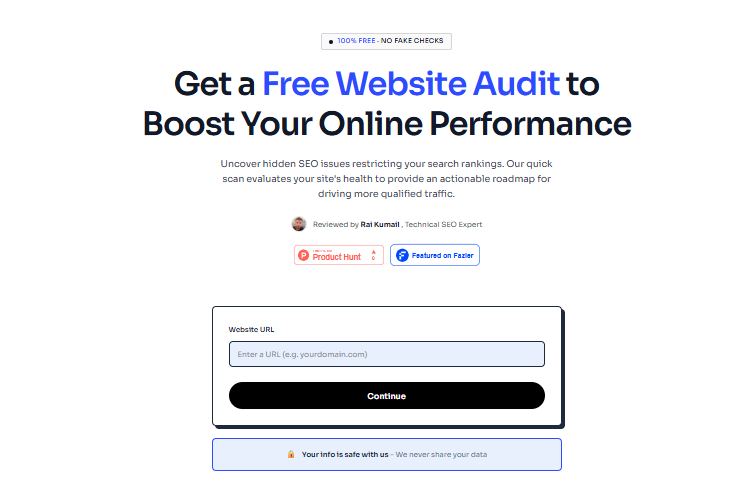
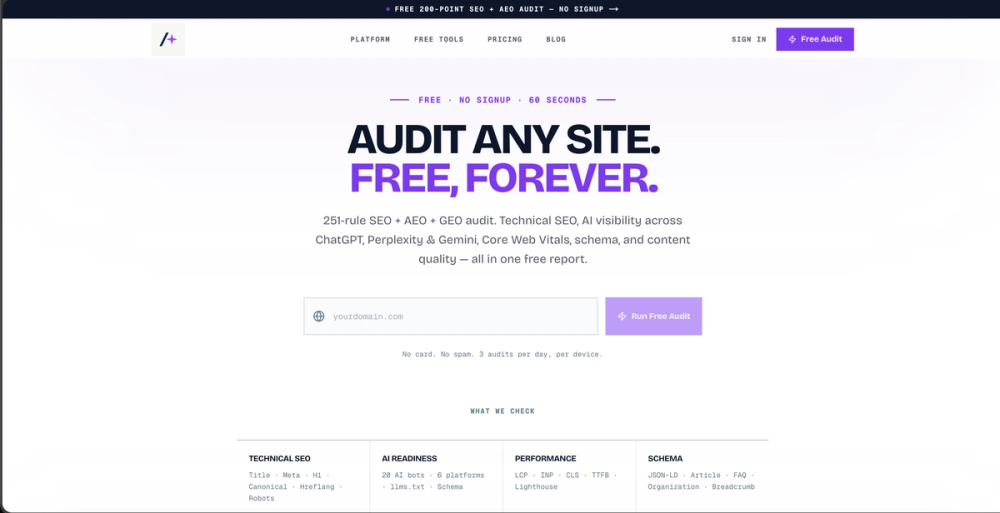
How does the free audit work without signup? The site promotes a free 200-point SEO + AEO audit requiring no registration. This appears designed as a lead generation tool offering immediate value while demonstrating platform capabilities. Full ongoing monitoring requires account creation.
Conclusion
Stackwise Rank addresses a genuine gap in the SEO tooling landscape: visibility into how AI answer engines perceive and cite brands. As search behavior shifts toward conversational AI interfaces, understanding LLM citation patterns becomes increasingly material for digital presence.
The platform's strongest value proposition lies in its automated technical remediation-reducing the friction between audit findings and implemented fixes through GitHub integration. For teams struggling with technical debt and developer bandwidth constraints, this automation may deliver tangible time savings.
However, prospective users should approach AI content generation capabilities with realistic expectations. While the Content Engine produces structured drafts optimized for citation, human editorial oversight remains non-negotiable for publication-ready material. The monthly article limits (10-80 depending on tier) also constrain high-volume content operations.
Pricing transparency could be improved-specific tier costs require inquiry rather than being publicly available. The 14-day money-back guarantee and free tier provide risk-mitigated entry points for evaluation.
Organizations heavily invested in WordPress, Webflow, or Shopify will find the native publishing integrations valuable. Agencies managing multiple clients benefit from white-label capabilities and client portals available on higher tiers.
Ultimately, Stackwise Rank appears best suited for growth teams and agencies already committed to AI-forward SEO strategies who need consolidated tooling rather than point solutions. Traditional SEO practitioners may find the AI-specific features valuable additions to existing workflows, though likely not complete replacements for established toolsets.
Before committing, verify current SOC 2 certification status if handling security-sensitive data, and test the free audit to evaluate alignment with your specific technical SEO needs.