
Introduction
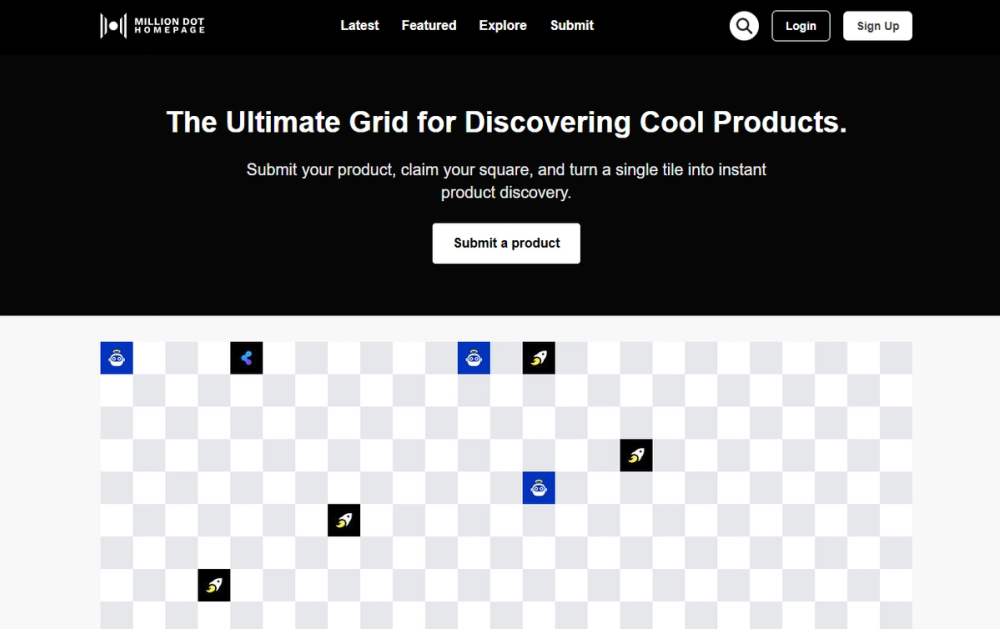
Million Dot Homepage presents itself as a visual grid for discovering new products and tools. The public page is relevant for makers who want a lightweight product discovery surface and for visitors who prefer browsing tools by category, featured tiles, and short product descriptions rather than reading a long directory list.
The clearest value is the simple visual positioning: submit a product, claim a square, and make it visible in a grid-style discovery experience. A careful reader should still verify how submissions are reviewed, whether placement options cost anything, and what visibility a listed product can realistically expect.
Key Features
- Visual product grid built around product tiles and discovery squares.
- Public discovery sections such as Latest, Featured, Explore, Search, Login, and Sign Up.
- Featured product examples across categories, including digital banking, sprite generation, carousel creation, load testing, property management, telehealth, marketing data, and health-related tools.
- Category navigation covering areas such as AI Assistants, Analytics & Data, Chrome Extensions, Content Creation, Customer Support, and Design Tools.
- Submit-oriented positioning that invites makers to add a product and claim a square.
- Visible sponsor and advertising placements alongside the main discovery experience.
Use Cases
Million Dot Homepage appears useful for founders, indie makers, and SaaS teams that want another public surface where a product can be presented in a compact, visual format. The site's grid concept may fit products that can be understood quickly through a name, category, and short description.
For visitors, the site offers a browsing experience for discovering tools across several software categories. Someone researching AI tools, analytics products, design utilities, or Chrome extensions can scan the available tiles and category labels before deciding which product pages deserve closer review.
The practical limitation is that the available page does not explain ranking logic, review criteria, traffic expectations, or how long a product remains visible. Makers should treat it as a discovery channel to evaluate, not as a guaranteed acquisition source.
Pricing
The public evidence does not show clear pricing, plan tiers, submission fees, or refund terms for Million Dot Homepage. Since the page encourages users to submit a product and claim a square, makers should check the submission flow before relying on it for launch planning, especially if placement, sponsorship, or featured visibility involves a paid option.
User Experience and Support
The site appears designed around fast scanning: a homepage headline, navigation links, featured products, sponsor content, and category labels all appear on the primary page. This gives visitors a quick sense of what kinds of tools are listed without requiring a complex onboarding flow.
Support details are limited in the visible evidence. A Customer Support category is present, but that appears to be a product category rather than a direct support channel for the site itself. Users should verify whether Million Dot Homepage provides contact details, help documentation, or submission support during the sign-up or submission process.
Technical Details
The visible site content does not disclose the underlying technology stack, API access, moderation process, analytics dashboard, or integration options for submitters. The public page does show category signals such as Analytics & Data and Chrome Extensions, but those describe listed product categories rather than confirmed technical capabilities of Million Dot Homepage itself.
From an evaluator's perspective, the main technical question is not the stack behind the site, but what submitters can manage after listing: profile edits, category selection, tracking, sponsor placement, and update controls. Those details are not clear from the fetched homepage and should be checked before treating the platform as part of a repeatable product launch workflow.
Pros and Cons
Pros
- The visual grid concept makes product discovery easy to understand at a glance.
- The homepage shows multiple product examples, which helps visitors understand the listing style.
- Category labels make the browsing experience more structured than a plain feed.
- The submit-and-claim-square message gives makers a clear next action.
Cons
- Pricing and placement terms are not visible on the fetched page.
- The page does not make traffic, ranking, or review criteria clear.
- Support routes for submitters are not obvious from the visible evidence.
- Sponsor and ad content may require visitors to distinguish promoted items from regular discovery results.
FAQ
What is Million Dot Homepage?
Million Dot Homepage is a visual product discovery site that presents new products and tools in a grid-style format. Its public page describes the experience as submitting a product, claiming a square, and turning that tile into product discovery.
Who is Million Dot Homepage suited for?
It appears suited for indie makers, startup founders, and software teams that want a compact public listing for a product. It may also be useful for visitors who enjoy browsing tools visually across categories such as AI Assistants, Analytics & Data, Content Creation, and Design Tools.
What can users clearly verify from the public page?
Users can verify the homepage positioning, the visual grid concept, navigation links such as Latest and Explore, featured product examples, sponsor content, and several category labels. The page also shows a submission-oriented call to action around claiming a square.
Does Million Dot Homepage show pricing or submission fees?
Pricing is not clearly visible in the fetched homepage evidence. Anyone planning to submit a product should check the submission process directly to confirm whether a basic listing is free, whether featured placement costs extra, and whether sponsor options have separate terms.
What should makers check before relying on a listing?
Makers should verify review requirements, edit controls, placement rules, category selection, expected approval timing, and whether the site provides performance or traffic analytics. These details matter because a visual listing can help with exposure only if the submission terms and visibility model fit the launch plan.
Is Million Dot Homepage only for AI products?
No. The visible categories and featured examples include AI-related tools, but the public page also references analytics, Chrome extensions, design tools, business software, customer support, telehealth, and other product types. The site appears broader than a single AI-tool catalog.
Does the site provide documentation or support information?
The fetched homepage does not show detailed documentation or a clear support route for submitters. Users should look for contact information, help pages, or guidance during account creation or submission before assuming support is available.
Conclusion
Million Dot Homepage is a straightforward visual discovery surface for products and tools, with a clear emphasis on product tiles, categories, and featured listings. Its public page makes the browsing concept easy to grasp, but pricing, support, review criteria, and visibility terms need direct verification.
For makers, it is worth evaluating as an additional product discovery channel if the submission flow and placement model match their goals. For visitors, it offers a quick way to scan emerging tools without navigating a dense software directory.