
Introduction
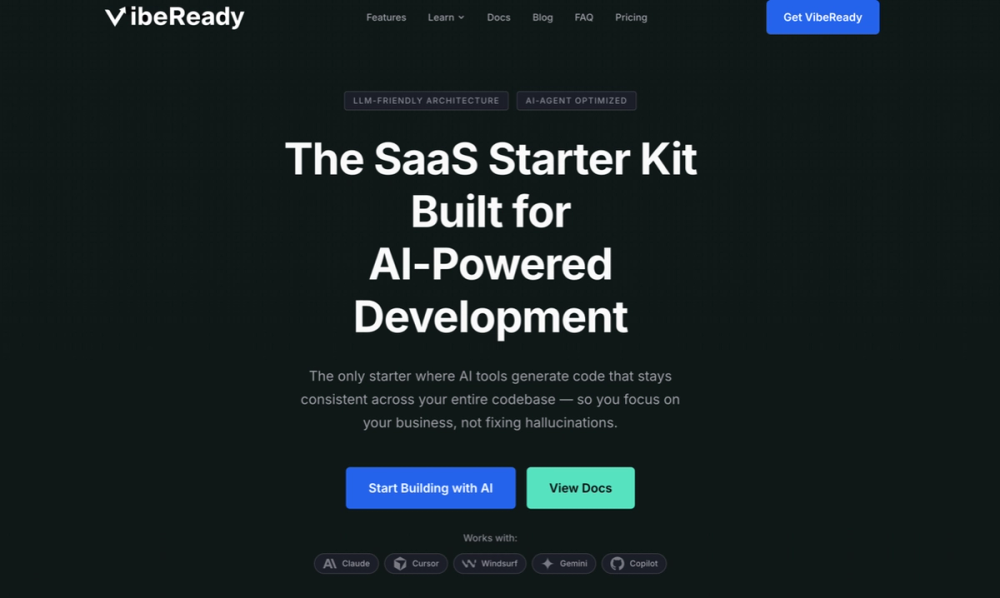
VibeReady is an AI-native Next.js SaaS starter kit for developers and teams building production software with AI coding tools. The public site presents it as a template that combines a modern SaaS foundation with an AI Framework designed to keep generated code consistent across the codebase. Its strongest fit is for builders who want to own their code, ship AI-agent features, and avoid turning every AI-assisted change into a cleanup project.
Key Features
- Next.js SaaS starter foundation with authentication, billing, multi-tenancy, dashboard patterns, background jobs, monitoring, analytics, and deployment infrastructure.
- AI Framework with smart context routing, a skill library, living documentation, quality gates, and tutorials.
- Built-in AI Assistant using Vercel AI SDK, tool calling, role-based access, and multi-provider support.
- AI agent starter features including streaming chat, OpenRouter support, tool calling, multi-tenant agent isolation, usage tracking, and MCP extensibility.
- Infrastructure support including Terraform for GCP, Cloud Run deployment, GitHub Actions CI/CD, and Docker Compose for local development.
- Documentation and workflows designed for AI coding tools such as Claude, Cursor, Windsurf, Gemini, and Copilot.
Use Cases
VibeReady is most relevant for technical founders, solo developers, and product teams that want to build a SaaS product with AI-assisted development from the beginning. The public page focuses on a common problem: AI coding tools can produce fast output, but without shared conventions, context, tests, and documentation, the codebase can drift.
It is also a fit for teams building AI-agent functionality into their own SaaS products. The AI agent starter page describes prebuilt infrastructure for streaming chat, tool calling, provider routing, role-based access, multi-tenancy, usage tracking, and MCP-based extension points.
Another use case is replacing a no-code or hosted prompt-building workflow with owned Next.js code. The site compares VibeReady with tools such as Bolt.new and emphasizes production-ready architecture, generated documentation, and code ownership rather than a hosted prototype flow.
Pricing
VibeReady pricing starts at $149. The public page describes an AI Framework Only option at a $149 one-time payment and states there are no subscriptions, no per-seat fees, and unlimited projects. The site also references agent features being included in the Full Kit at $399. Readers should verify the current VibeReady pricing before purchasing, including what each kit includes, whether discounts are active, and how updates are delivered.
User Experience and Support
The product experience is built around getting a production SaaS foundation running quickly, then guiding AI tools through documented patterns rather than leaving them to infer the architecture. The site highlights setup, docs, tutorials, PRD-driven workflows, agent skills, living READMEs, and quality gates.
Support signals are mostly product-documentation oriented. VibeReady provides docs, blog content, FAQ, comparisons, tutorials, and learning pages. The available evidence does not show a traditional support SLA for every plan, so teams with business-critical needs should check whether purchase support, update support, or private implementation help is included.
Technical Details
VibeReady's stack is explicit. The public page lists Next.js 16, TypeScript, PostgreSQL, Prisma, Clerk, Stripe, Tailwind, Terraform, Vercel AI SDK, Inngest, Resend, and shadcn/ui. It also mentions RESTful endpoints with auto-generated OpenAPI docs, role-based permissions, multi-tenant data isolation, feature flags, transactional email, Sentry error tracking, Web Vitals, and privacy-friendly analytics.
For AI functionality, VibeReady uses Vercel AI SDK, OpenRouter for multi-provider LLM access, tool calling with validated schemas, role-based permissions, organization-scoped execution, token usage tracking, and MCP extensibility. That makes the product more than a visual template; it is positioned as a software architecture and workflow system for building SaaS products with AI coding tools.
Pros and Cons
Pros
- Clear fit for AI-assisted SaaS development, not just a generic Next.js starter.
- Strong technical detail around auth, billing, multi-tenancy, AI agents, infrastructure, and deployment.
- One-time pricing may appeal to teams avoiding per-seat template subscriptions.
- The AI Framework, living documentation, and quality gates address real issues in AI-generated code maintenance.
Cons
- The product is best suited for developers comfortable with a modern TypeScript and Next.js stack.
- Teams not using AI coding tools may not need the full AI Framework layer.
- GCP, Terraform, Clerk, Stripe, Prisma, and the listed stack choices may not match every team's preferred architecture.
- Buyers should verify license terms, update policy, refund policy, support scope, and the exact difference between AI Framework Only and the Full Kit.
FAQ
What is VibeReady?
VibeReady is an AI-native Next.js SaaS starter kit. It combines a production SaaS template with an AI Framework intended to help tools like Claude, Cursor, Windsurf, Gemini, and Copilot follow the project's architecture and conventions.
Who is VibeReady best suited for?
It is best suited for developers, technical founders, and SaaS teams building with AI coding tools. It is especially relevant when the team wants owned code, reusable workflows, and production patterns rather than a prototype-only builder.
What does the AI Framework include?
The public site lists smart context routing, a skill library, living documentation, quality gates, and tutorials. These are designed to give AI coding tools the right context and enforce consistent development patterns.
Can VibeReady be used to build AI agent features?
Yes. The site describes an AI agent starter with streaming chat, OpenRouter, tool calling, Vercel AI SDK, multi-tenant isolation, usage tracking, and MCP extensibility.
What technology stack does VibeReady use?
The visible stack includes Next.js 16, TypeScript, PostgreSQL, Prisma, Clerk, Stripe, Tailwind, Terraform, Vercel AI SDK, Inngest, Resend, and shadcn/ui. It also references GCP Cloud Run, GitHub Actions, Docker support, Sentry, and Web Vitals.
How much does VibeReady cost?
The public page says VibeReady starts from $149 and describes an AI Framework Only option at $149 one time. The site also references Full Kit agent features at $399, so buyers should confirm current package details before purchase.
What should teams verify before choosing VibeReady?
Teams should verify license terms, update access, support scope, refund policy, deployment assumptions, and whether the stack aligns with their existing engineering preferences. They should also confirm which AI-agent features are included in each package.
Conclusion
VibeReady is positioned for a specific kind of builder: someone using AI coding tools to create a serious SaaS product and wanting structure around that process. Its public evidence is unusually detailed, covering the application stack, AI agent infrastructure, quality gates, documentation, and pricing direction. The main decision is not whether it is feature-rich, but whether its opinionated Next.js, AI Framework, and infrastructure choices match the way your team wants to build.